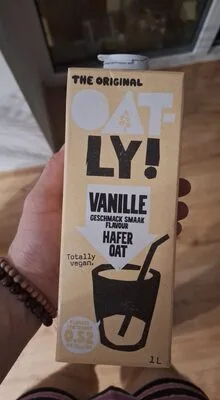
Oatly! Vanille Flavour Oat
Vanilla oat based drinks
36Poor
No additives declaredNOVA 4
7394376619267 · 1l
Ingredients, most to least
Mostly wasser, hafer (11%) and zucker (2.3%).
A percentage with ≤ in front of it is a ceiling, not a measurement: the most that can be in the pack, given what the label declares and the order the list runs in. A plain percentage is one the label states outright.
- 3 moderate
- 5 not rated
- 4 no concern
- 2 benefit
- 1Wasser≤ 86.7%No concern
Water.
Open Food Facts ingredient taxonomy
- 2HAFER11%Benefit
A whole grain: the bran and germ are retained, so the fibre stays with it.
WHO guideline on carbohydrate intake, 2023
- 3Zucker2.3%Moderate
A free sugar. WHO recommends limiting free sugars to under 10% of energy intake, and suggests under 5% for further benefit.
WHO guideline on sugars intake, 2015
- 4Rapsöl≤ 2.3%Benefit
Predominantly unsaturated fat, which is what WHO recommends saturated fat be replaced with.
WHO guideline on saturated fatty acid intake, 2023
- 5Mineralien≤ 2.3%Not rated
No published position is recorded here for this ingredient. That is a gap in this register, not a statement that it is fine.
Open Food Facts ingredient taxonomy
- Calciumcarbonat≤ 2.3%No concern
No safety concern identified at permitted levels.
EFSA opinion, 2011E170I
- Calciumphosphate≤ 1.2%Moderate
Covered by the 2019 EFSA phosphate group acceptable daily intake, which dietary exposure exceeds across most groups.
At most 1.2% of the product, because its place in the ingredient list puts it at no more than 1.2%.EFSA opinion, 2019E341
- Kaliumiodid≤ 0.2%Not rated
No published position is recorded here for this ingredient. That is a gap in this register, not a statement that it is fine.
Open Food Facts ingredient taxonomy
- 6natürliches Aroma≤ 2.3%No concern
Flavourings from a natural source. The specific substances are not required to be named on the label, so nothing more can be said about them from the label alone.
EU Regulation 1334/2008
- 7Salz≤ 0.2%Moderate
WHO recommends adults consume less than 5 g of salt a day, which most populations exceed.
WHO guideline on sodium intake, 2023
- 8vitamine≤ 0.2%Not rated
No published position is recorded here for this ingredient. That is a gap in this register, not a statement that it is fine.
Open Food Facts ingredient taxonomy
- 9vitamin D2≤ 0.2%Not rated
No published position is recorded here for this ingredient. That is a gap in this register, not a statement that it is fine.
Open Food Facts ingredient taxonomy
- 10Riboflavin≤ 0.2%No concern
A B vitamin; no safety concern identified at permitted levels.
EFSA opinion, 2013E101
- 11vitamin B12≤ 0.2%Not rated
No published position is recorded here for this ingredient. That is a gap in this register, not a statement that it is fine.
Open Food Facts ingredient taxonomy
Show the text as printed
Wasser, HAFER 11%, Zucker 2,3%, Rapsöl, Mineralien (Calciumcarbonat, Calciumphosphate, Kaliumiodid), natürliches Aroma, Salz, Vitamine (D2, Riboflavin, B12).
Percentages marked est. are Open Food Facts’ estimate from the order and the declared figures, not numbers off the pack. An ingredient marked not rated is a gap in this register rather than a clean bill of health.
How this number was made
36/100
Poor
- Nutri-Score
- e
- NOVA
- 4 of 4
- Additives
- 0
Nutrition is what pulls this down: 20 out of 100 at 55% of the weight. What holds it up is additives, at 100.
Nutrition
55% × 20
Additives
25% × 100
Processing
20% × 0
Column width is the weight you set. Column height is that axis out of 100. The shaded area is the score.
NutritionGrade E · 10 points20/100+11.0
Counts against it
- Energy284.5 kJ per 100 ml6/10
- Sugars5.9 g per 100 ml4/10
- Saturated fat0.3 g per 100 ml0/10
- Salt0.11 g per 100 ml0/20
- Non-nutritive sweeteners0 number per 100 ml0/4
Counts for it
- Protein1.1 g per 100 ml0/7
- Fibre0.8 g per 100 ml0/5
- Fruit, vegetables and legumes0% of the product0/6
- Nutri-Score points10 negative − 0 positive = 10, which Open Food Facts grades E. Among drinks, grade A is reserved for water.
Higher points in the first block mean a worse food; higher points in the second mean a better one. Open Food Facts computes them with the 2023 Nutri-Score algorithm, and the grade band is stretched onto 0–100 here so the letter and the number always agree.
AdditivesNone declared100/100+25.0
- No additives foundThe parsed ingredient list contains no E-numbered additives.0/100
ProcessingNOVA 40/100+0.0
- NOVA group 4 of 4Ultra-processed formulation, typically containing ingredients not used in home cooking.0/100
Organic labelNone on record0 · unweighted
- No organic certification foundOrganic certification describes how the food was farmed, not what is in it. This axis is weighted 0 by default for that reason.0/100
Panel, per 100 g
| Energy | 68kcal |
|---|---|
| Fat | 2.6g |
| of which saturates | 0.3g |
| Carbohydrate | 9.6g |
| of which sugars | 5.9g |
| Fibre | 0.8g |
| Protein | 1.1g |
| Salt | 0.11g |
Within its own category
Compared against vanilla oat based drinks rather than against all food. A low absolute score on olive oil or nuts is a known Nutri-Score artefact; the useful question is how this compares to the other things on the same shelf.
Loading the category…
Product data from Open Food Facts, licensed ODbL. Open this record to correct or complete it.
Compare
The decision in an aisle is comparative. Open a second product and it lands beside this one, or share this URL with ?vs= and another barcode.