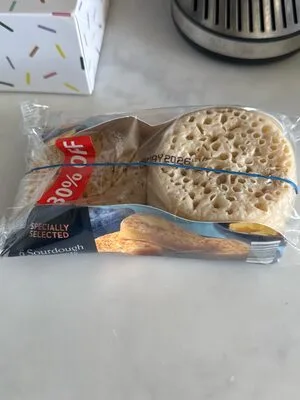
6 Sourdough Crumpets
Extra Special · Special breads
46Fair
3 additives1 flaggedNOVA 4
4088600456461 · 6
Ingredients, most to least
Mostly white wheat flour, water and wheat sourdough (7%).
A percentage with ≤ in front of it is a ceiling, not a measurement: the most that can be in the pack, given what the label declares and the order the list runs in. A plain percentage is one the label states outright.
- 2 moderate
- 3 watch
- 5 not rated
- 5 no concern
- 1White Wheat FlourNot rated
No published position is recorded here for this ingredient. That is a gap in this register, not a statement that it is fine.
Open Food Facts ingredient taxonomy
- Wheat FlourWatch
Refining removes the bran and the germ, and with them most of the fibre.
Composition of cereal fractions
- Calcium Carbonate≤ 50%No concern
No safety concern identified at permitted levels.
EFSA opinion, 2011E170I
- Iron≤ 33.4%Not rated
No published position is recorded here for this ingredient. That is a gap in this register, not a statement that it is fine.
Open Food Facts ingredient taxonomy
- Niacin≤ 25%Not rated
No published position is recorded here for this additive, so it contributes nothing to the score in either direction.
Open Food Facts additive recordE375
- Thiamin≤ 20%Not rated
No published position is recorded here for this ingredient. That is a gap in this register, not a statement that it is fine.
Open Food Facts ingredient taxonomy
- 2Water≤ 50%No concern
Water.
Open Food Facts ingredient taxonomy
- 3WHEAT SOURDOUGH7%Not rated
No published position is recorded here for this ingredient. That is a gap in this register, not a statement that it is fine.
Open Food Facts ingredient taxonomy
- Water7%No concern
Water.
Open Food Facts ingredient taxonomy
- Wheat Flour7%Watch
Refining removes the bran and the germ, and with them most of the fibre.
Composition of cereal fractions
- 4Yeast≤ 7%No concern
A leavening agent.
Open Food Facts ingredient taxonomy
- 5Diphosphates≤ 7%Moderate
Covered by the 2019 EFSA phosphate group acceptable daily intake, which dietary exposure exceeds across most groups.
At most 7% of the product, because its place in the ingredient list puts it at no more than 7%.EFSA opinion, 2019E450 · raising agent
- 6Potassium Carbonate≤ 7%No concern
No safety concern identified at permitted levels.
EFSA re-evaluationE501I · raising agent
- 7Salt≤ 7%Moderate
WHO recommends adults consume less than 5 g of salt a day, which most populations exceed.
WHO guideline on sodium intake, 2023
- 8Potassium Sorbate≤ 7%Watch
EFSA reduced the acceptable daily intake in 2015 and noted exceedance in some groups.
At most 7% of the product, because its place in the ingredient list puts it at no more than 7%.EFSA opinion, 2015E202 · preservative
Show the text as printed
White Wheat Flour (Wheat Flour, Calcium Carbonate, Iron, Niacin, Thiamin), Water, WHEAT SOURDOUGH (7%) (Water, Fermented Wheat Flour), Yeast, Raising Agents: Diphosphates, Potassium Carbonate; Salt, Preservative: Potassium Sorbate.
Percentages marked est. are Open Food Facts’ estimate from the order and the declared figures, not numbers off the pack. An ingredient marked not rated is a gap in this register rather than a clean bill of health.
How this number was made
46/100
Fair
- Nutri-Score
- c
- NOVA
- 4 of 4
- Additives
- 3
Nutrition carries 55% of the weight and scores 54 out of 100, so it decides this almost on its own.
Nutrition
55% × 54
Additives
25% × 65
Processing
20% × 0
Column width is the weight you set. Column height is that axis out of 100. The shaded area is the score.
NutritionGrade C · 5 points54/100+29.7
Counts against it
- Energy754 kJ per 100 g2/10
- Sugars0.8 g per 100 g0/15
- Saturated fat0.1 g per 100 g0/10
- Salt1.01 g per 100 g5/20
Counts for it
- Protein5.2 g per 100 g2/7
- Fibre2.3 g per 100 g0/5
- Fruit, vegetables and legumes0% of the product0/5
- Nutri-Score points7 negative − 2 positive = 5, which Open Food Facts grades C
Higher points in the first block mean a worse food; higher points in the second mean a better one. Open Food Facts computes them with the 2023 Nutri-Score algorithm, and the grade band is stretched onto 0–100 here so the letter and the number always agree.
Additives3 declared · worst: moderate65/100+16.3
- E450 · DiphosphatesCovered by the 2019 EFSA phosphate group acceptable daily intake, which dietary exposure exceeds across most groups. (EFSA opinion, 2019) At most 7% of the product, because its place in the ingredient list puts it at no more than 7%, which is too much to discount the penalty.25/100
- E501I · Potassium carbonatesNo safety concern identified at permitted levels. (EFSA re-evaluation)0/100
- E202 · Potassium sorbateEFSA reduced the acceptable daily intake in 2015 and noted exceedance in some groups. (EFSA opinion, 2015) At most 7% of the product, because its place in the ingredient list puts it at no more than 7%, which is too much to discount the penalty.10/100
ProcessingNOVA 40/100+0.0
- NOVA group 4 of 4Ultra-processed formulation, typically containing ingredients not used in home cooking.0/100
Organic labelNone on record0 · unweighted
- No organic certification foundOrganic certification describes how the food was farmed, not what is in it. This axis is weighted 0 by default for that reason.0/100
Panel, per 100 g
| Energy | 180kcal |
|---|---|
| Fat | 0.5g |
| of which saturates | 0.1g |
| Carbohydrate | 37.6g |
| of which sugars | 0.8g |
| Fibre | 2.3g |
| Protein | 5.2g |
| Salt | 1.01g |
Within its own category
Compared against crumpets rather than against all food. A low absolute score on olive oil or nuts is a known Nutri-Score artefact; the useful question is how this compares to the other things on the same shelf.
Loading the category…
Product data from Open Food Facts, licensed ODbL. Open this record to correct or complete it.
Compare
The decision in an aisle is comparative. Open a second product and it lands beside this one, or share this URL with ?vs= and another barcode.